
Lien Waiver for Contractors in NJ: A Clear Guide for 2026

Could a signature meant to document payment leave you unsure about what has actually been paid? For contractors handling home additions Medford NJ, lien waivers can involve several parties, from the general contractor to subcontractors and suppliers. Clear wording, accurate payment details, and careful timing matter.
It’s understandable to treat a waiver as routine paperwork when a project is moving forward and payment is expected. But conditional and unconditional language can have different implications. A signed document shouldn’t replace checking that funds have cleared and that the waiver accurately describes the payment and work covered.
This guide explains common waiver types, what to review before signing, and how to organize payment records across a New Jersey construction project. You’ll also learn why documentation is a practical part of project management, and when to ask qualified New Jersey counsel about legal requirements or waiver language. A consistent process can make payment closeouts more orderly and give each participant a clearer record of what has been paid.
Table of Contents
What Is a Lien Waiver for Contractors in NJ, and What Does It Document?
Conditional vs. Unconditional Lien Waivers: Match the Form to Payment Status
New Jersey Lien Waiver Questions: Avoid Assuming One Form Fits Every Project
A Practical Lien Waiver Review Checklist for Contractors and Subcontractors
Build a Reliable Payment-Document Process for NJ Construction Projects
What Is a Lien Waiver for Contractors in NJ, and What Does It Document?
A lien waiver is a payment-related construction document that records a party’s statement about payment claims connected to particular work. Contractors, subcontractors, or suppliers may encounter one during a progress payment or at project closeout. Its practical effect depends on the wording, the payment involved, and applicable law, so the title alone isn’t enough to establish what it covers.
A Mechanic's lien is a legal claim associated with work or materials provided to improve property. A waiver may address claims related to payment for that work, but it shouldn’t be confused with proof that funds have cleared or a complete project record. A lien waiver generally documents a payment-related claim for defined work and a defined period. Its exact wording matters because it indicates what the document appears to cover.
On a project involving home additions Medford NJ, a contractor might receive a subcontractor’s waiver alongside a progress payment. Review it against the relevant agreement and payment records. Don’t treat it as routine paperwork or a substitute for those records.
What information does a construction lien waiver usually identify?
Common details include the project, the parties, the payment amount, and the work or payment period covered. Some forms also describe exclusions, such as unpaid change work or amounts not included in that payment. Forms vary, so don’t assume every document uses the same fields or has the same legal effect.
Check that the covered period and any exclusions are easy to identify. Compare the waiver with the contract, invoice, and payment records. Ask for clarification if the scope or amount doesn’t align.
How is a lien waiver different from a lien release?
In general usage, a waiver addresses a claim or right in connection with payment, while a release may describe a document intended to discharge or resolve a claim. The terms can vary by jurisdiction and by the document itself. Neither title automatically proves that every possible payment claim has been eliminated.
An invoice requests or records charges, a receipt acknowledges payment, and a contract sets out agreed terms. These documents serve different purposes and aren’t interchangeable with a waiver or release. If a document’s title conflicts with its operative language, pause and seek review from qualified New Jersey construction counsel before relying on it.
Conditional vs. Unconditional Lien Waivers: Match the Form to Payment Status
The practical distinction is whether receipt of a specified payment is written as a condition of the waiver. A payment promise, remittance notice, or issued check isn’t the same as funds confirmed in the account. That difference matters when a contractor or subcontractor is asked to sign while a progress payment is still being processed.
In common industry usage, conditional wording ties the waiver to receipt of the payment identified in the document. Unconditional wording may appear to acknowledge payment without making receipt a stated condition. In New Jersey, however, the label alone can mislead: a waiver of lien rights is effective only upon and to the extent payment is actually received. Read the language carefully, and have a New Jersey construction attorney review legal questions. The New Jersey State Bar Association is a professional resource for locating information about legal guidance in the state.
When might a conditional waiver be considered?
If payment is expected but hasn’t cleared, conditional language can make the document’s stated relationship to that payment clearer. Check that it names the correct project and parties, identifies the amount and payment period, and covers only the intended work. For example, on home additions Medford NJ, compare a subcontractor’s waiver for one progress payment with the corresponding invoice and payment record. Exact legal consequences depend on the wording and applicable New Jersey law.
What should contractors check before signing an unconditional waiver?
Start with evidence, not assumption. Compare the stated amount with bank records and the project payment ledger. Then look for language that could include unpaid retainage, disputed change orders, or other amounts meant to remain excluded. If payment status, scope, or wording is unclear, pause and seek legal review rather than relying on the form title.
For a construction project where payment records need to stay coordinated with the work, learn about structural additions from Black Bear Construction. Clear project documentation supports communication, but it isn’t a substitute for legal advice about a waiver.
New Jersey Lien Waiver Questions: Avoid Assuming One Form Fits Every Project
A waiver form that looks straightforward may not address the details of a particular New Jersey project. The relevant review can depend on the project type, contract terms, payment stage, parties involved, and the document’s exact wording. A form used for one progress payment, for example, may not fit a final payment or account for a subcontractor’s separate claims.
Don’t assume a generic lien waiver is valid or suitable for every New Jersey construction project. Verify current rules and the document’s wording before relying on it. A form’s title isn’t a legal conclusion. The language, payment it addresses, and project circumstances all matter.
Which New Jersey requirements should contractors verify?
Before using or signing a form, ask qualified New Jersey construction counsel to verify which statutes, notice rules, deadlines, and document language apply to the specific project. Where official state sources are available, check the current source itself rather than relying on an old template or online summary. Keep a note of the source and its publication or update date with the project records so the basis for the review is clear.
Don’t assume a particular waiver form is mandatory, or that a form is effective simply because it is commonly circulated. Those conclusions require current, qualified legal review. This is especially important if a form is reused across project types or payment stages.
When should a contractor ask for legal review?
Seek counsel’s review if payment is disputed, a waiver includes broad release language, exclusions are unclear, or its terms conflict with the contract. Apply the same care when a project involves several tiers of subcontractors or suppliers. A prime contractor may need to understand how its payment documents relate to claims and records further down the payment chain.
For home additions Medford NJ, a project may involve a general contractor, specialty subcontractors, and suppliers whose invoices and payment periods don’t align. One form may not capture each party’s situation. Confirm who is signing, which work and payment are covered, and whether any amounts remain unresolved before relying on the document.
General information can help identify questions, but it can’t determine the right approach to an individual claim or dispute. Organize the contract, invoices, payment records, and waiver for review, then ask qualified New Jersey counsel to interpret legal requirements or advise on a specific situation.
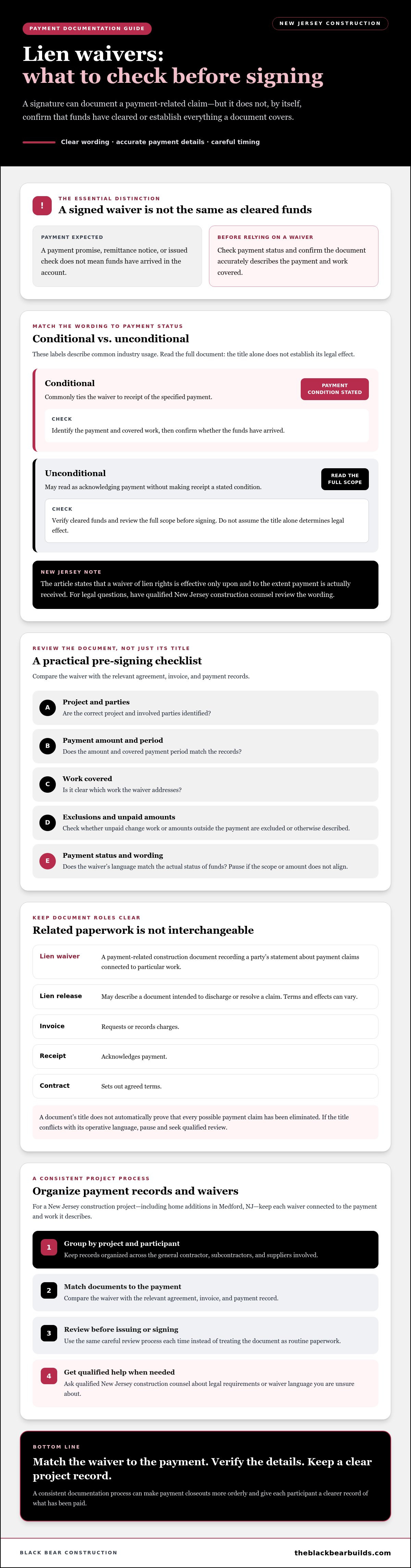
A Practical Lien Waiver Review Checklist for Contractors and Subcontractors
A consistent review before issuing or signing a waiver can catch mismatched amounts, incomplete exclusions, and payment assumptions before they become harder to resolve. Use these checks alongside the contract and project records. If the document’s legal effect is uncertain, ask qualified New Jersey construction counsel to review it.
Confirm the project and parties. Check that the project name or address and the names of the signing parties match the contract and payment records. If several subcontractors or suppliers are involved, make sure the waiver comes from the party whose payment claim it addresses.
Match the payment period and work. Identify the dates or progress period covered, then compare the described work with the invoice and project documentation. The waiver shouldn’t appear to cover work outside the intended payment period.
Verify the amount and payment status. Compare the stated amount with the payment ledger and supporting records. If funds haven’t cleared, check whether the waiver is expressly conditional on receiving the identified payment. A promise to pay or payment notice isn’t the same as confirmation in the bank.
Review the release language and exclusions. Read beyond the title. Look for language that could include unpaid retainage, disputed change orders, or other amounts not intended to be covered. Confirm that exclusions are stated clearly and match the parties’ agreed payment terms.
Pause if the paperwork conflicts. If the waiver differs from the contract, invoice, approved change documentation, or payment arrangement, don’t rely on memory or assume the difference is harmless. Ask the relevant parties to clarify the discrepancy, and seek legal review if the scope or legal effect remains unclear.
How can teams keep waiver records organized?
Maintain a project-specific log that records the document’s status, related payment status, date, and responsible reviewer. Store the signed waiver with the contract, invoice, payment confirmation, approved change documentation, and relevant correspondence. This creates a traceable record instead of a collection of scattered files.
Set a standard review point before payment processing and use it for each contractor, subcontractor, or supplier. For home additions Medford NJ, where participants may submit separate invoices and waivers, an orderly shared record can help the team spot gaps and follow up. It supports coordination, but doesn’t replace legal advice.
If you’re planning a project, explore Black Bear Construction’s structural additions and consider how clear project records can support coordination from the outset.
Build a Reliable Payment-Document Process for NJ Construction Projects
A dependable payment process gives each project participant a clear record of what was invoiced, reviewed, paid, and documented. It also reduces the chance that an owner, contractor, subcontractor, or supplier will rely on different assumptions about the same payment.
How should lien waivers fit into project payment administration?
Use the same sequence for each payment cycle, and assign responsibility at the outset:
Review the invoice. Confirm the project, billing period, work described, amount, and any approved change documentation against the contract.
Confirm payment status. Record when payment is processed and verify receipt before treating it as cleared. If a waiver is requested earlier, check whether its wording makes the waiver conditional on receiving that payment.
Review the waiver. Compare its parties, amount, covered work, payment period, and exclusions with the invoice and project records. Resolve discrepancies before it is signed or relied upon.
File the complete record. Store the signed document with its supporting invoice, payment confirmation, contract, approved changes, and relevant correspondence.
Decide who prepares each document, who checks it, who is authorized to sign, and who maintains the project file. Put disputed amounts and exceptions in writing with the related records, rather than relying on a verbal understanding. For home additions Medford NJ, this process can help keep an owner’s payment records aligned with contractor documentation and separate subcontractor or supplier invoices.
When is outside professional guidance worthwhile?
A New Jersey construction attorney can review legal requirements, interpret waiver language, or advise on disputed rights and individual claims. Keep that legal review separate from routine project administration. If the team is unsure how to track invoices, confirmations, and signed forms consistently, consult the accounting or administrative lead responsible for payment records.
Clear communication matters as much as orderly filing. Tell each participant which payment a waiver relates to, what work it covers, and how exceptions will be documented. A consistent process helps prevent avoidable confusion, but it doesn’t guarantee a particular legal outcome.
For a broader project, explore this guide to full-home renovation planning in South Jersey. If you’re considering an addition or residential construction project, discuss the project’s scope with a contractor. The guide to structural home additions in South Jersey offers another starting point for planning the work.
Keep Payment Records Clear as Your Project Moves Forward
A reliable lien-waiver process starts with clear wording, confirmed payment status, and records that connect each document to the right project, party, and work period. Before signing or issuing a waiver, compare it with the contract, invoice, and payment records. If the document’s legal effect or New Jersey requirements are unclear, consult qualified New Jersey construction counsel.
For homeowners considering home additions Medford NJ, organized project communication can help owners, contractors, subcontractors, and suppliers keep payment documentation aligned. Black Bear Construction is a general contractor based in Medford Township, serving South Jersey and nearby Pennsylvania. The company provides full home renovations, structural additions, and interior construction services, along with commercial construction and emergency insurance work. It is a construction contractor, not a legal adviser.
If you’re planning an addition or renovation, discuss your residential construction project with Black Bear Construction. Share your project goals and scope to start a conversation about the work.
Frequently Asked Questions
What is a lien waiver for contractors in New Jersey?
A lien waiver is a construction payment document that may confirm payment or address claims connected to specified work, amounts, or periods. Its effect depends on the wording and applicable New Jersey law. For home additions Medford NJ, compare the waiver with the contract, invoice, and payment records before signing. Don’t assume a generic online template fits the project, and ask qualified New Jersey construction counsel to review legal questions.
What is the difference between a conditional and unconditional lien waiver?
A conditional waiver generally ties its effect to receipt of a specified payment, while an unconditional waiver may not state that condition. In New Jersey, a waiver of lien rights is effective only upon and to the extent payment is actually received, so the title alone doesn’t determine its effect. Before signing, check the amount, covered work, payment status, and exclusions. Ask counsel to review broad or unclear language.
Does New Jersey require a specific lien waiver form?
New Jersey does not have a statutory or official lien waiver form, according to the current information summarized for this guide. That doesn’t mean every custom or online form is suitable for every project. Requirements and legal effects may depend on current law, the contract, project type, and document wording. Ask a New Jersey construction attorney to verify applicable requirements before relying on a form labelled for the state.
Should a contractor sign an unconditional lien waiver before payment clears?
Don’t sign based only on an expected payment or verbal assurance. First compare the waiver with payment status, amount, work covered, and any exclusions, and check whether the funds have cleared. Although New Jersey law makes a waiver effective only upon and to the extent payment is received, an unconditional label can still create confusion or risk. If funds haven’t arrived or the wording is broad, pause and seek qualified legal advice.
When should a contractor issue a lien waiver?
Coordinate a waiver with the specific payment it addresses, while checking the contract, document wording, and applicable law. Keep the signed waiver with the related invoice and payment confirmation, and review its scope before using it for a partial payment. For projects in Medford Township, Marlton, Voorhees, Haddonfield, Collingswood, Haddon Heights, Woodbury, Mullica Hill, Berlin, Southampton, Mt. Laurel, Long Beach Island, Ocean City, Avalon, or Stone Harbor, consistent records can help participants stay aligned.
Can a lien waiver cover retainage or change orders?
It depends on the document’s wording and how those amounts are handled under the contract. Check whether the waiver includes, excludes, or leaves unclear retainage, pending change orders, disputed work, and unpaid balances. Don’t assume unresolved amounts are protected simply because they aren’t listed separately. If the document could affect a disputed or unpaid amount, request clarification and ask qualified New Jersey construction counsel to review its scope before you sign or rely on it.
How should contractors keep lien waiver records?
Keep every signed waiver with the related contract, invoice, payment confirmation, and project correspondence. A project log can track the parties, covered payment period, amount, signature date, and whether payment cleared. Store records by project so a contractor can distinguish documents for different subcontractors or suppliers. If a claim is disputed or the waiver’s legal effect is uncertain, preserve the records and consult qualified New Jersey counsel before changing or discarding them.


Comments