
Benefits of In-House Renovation Financing: Costs and Options

The simplest financing route isn’t automatically the least costly. The benefits of in-house renovation financing can include a more direct connection between funding and the renovation, with less need to coordinate separate financing and construction processes. Its value depends on the terms, fees, repayment schedule, and paperwork involved.
It’s reasonable to want a clear path from an approved project plan to completed work without overlooking what financing may cost over time. This guide compares financing through a general contractor with renovation loans, home equity loans, HELOCs, cash-out refinancing, and personal loans. You’ll see how paperwork, possible closing costs, and repayment structures can differ, and which factors matter when weighing your options. This comparison can help you understand where in-house financing may be convenient, where another approach may fit better, and what to consider before choosing how to fund a renovation.
Table of Contents
Additional paperwork and potential closing costs
In-house financing may cover approved renovation work and related costs, but eligible work depends on the financing arrangement. Repairs, home improvement projects, and upgrades may qualify. Before relying on that coverage, confirm which work and expenses are included in the financing documents.
Paperwork may include a detailed renovation plan, contractor bids or estimates, and sometimes an approved contractor list. Renovation loans also differ in timing, mortgage underwriting, and required steps. Some can combine renovation expenses with a home purchase or refinance in one mortgage, potentially resulting in one closing and one monthly payment.
DIY work has its own approval considerations. Homeowners completing improvements themselves may need approval from a local authority. HUD advises homeowners to understand all improvement costs before proceeding and to get more than one estimate for contractor work. The lowest estimate may not be the best fit for the project.
Choose by comparing required documents, eligible work, and total borrowing costs with your project scope.
Consolidation can simplify financing, but you still need to understand interest, payments, and service charges. HUD advises homeowners to account for these when assessing contractor job costs. Review how the financing treats repairs and upgrades, and whether the renovation amount is part of the primary mortgage or a separate credit arrangement. This distinction affects the number of payments and the documents tied to the work.
Financing through a general contractor
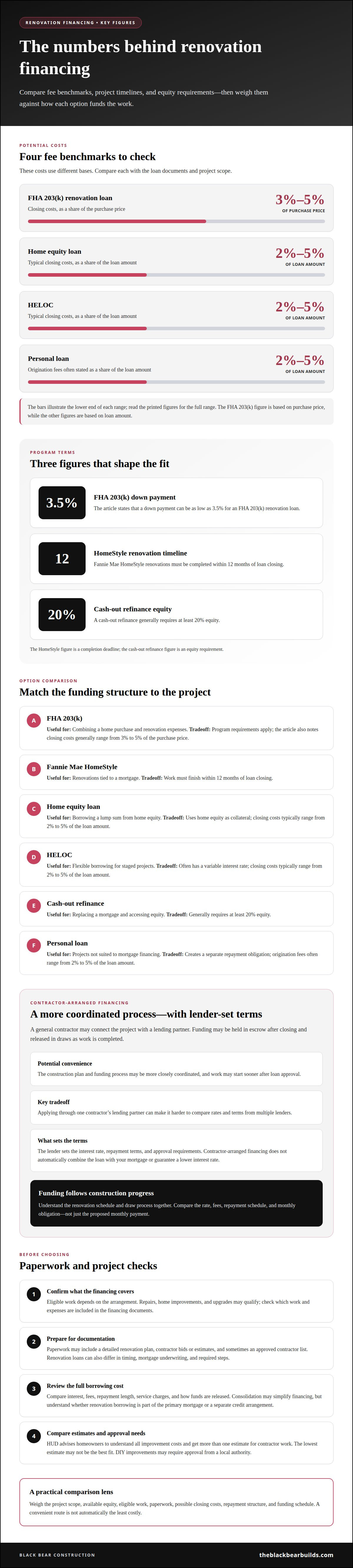
Some general contractors connect renovation projects with financing through a lending partner, bringing the construction plan and funding process into closer coordination. After loan approval, contractor-arranged financing may allow work to start sooner. The lender sets the interest rate, repayment terms, and approval requirements.
That convenience has a tradeoff: applying through one contractor’s lending partner can make it harder to compare rates and terms from multiple lenders. Your credit score, credit history, and debt-to-income ratio can affect eligibility and borrowing power for a home improvement loan. Compare the total repayment obligation, not just the proposed monthly payment.
Funding may also follow a staged process. Renovation funds are often held in escrow after closing and released in draws as work is completed. A project, for example, may receive funding in stages rather than as one upfront payment. This ties access to funds to construction progress, so understand the renovation schedule and payment process together.
Contractor-arranged financing differs from borrowing against home equity or refinancing a mortgage. A home equity loan or HELOC uses available equity, while a cash-out refinance replaces the existing mortgage with a larger one. Contractor-arranged financing connects the project to a lender, but doesn’t automatically combine the loan with your mortgage or guarantee a lower interest rate.
Before choosing, map out the sequence: identify the project scope, review the financing terms, then understand how funds are released during construction. Compare the lender’s rate, fees, repayment schedule, and monthly obligation with other options. That helps reveal whether coordinated financing suits the work or whether another borrowing structure better matches your housing and equity plans. Explore how financing and renovation planning can align around your project.
Comparing renovation financing options
The best fit depends on the project, available equity, and how you prefer to repay. An FHA 203(k) renovation loan can combine a home purchase and renovation expenses, with a down payment as low as 3.5%. Fannie Mae HomeStyle renovations must be completed within 12 months of loan closing.
Compare the payment structure, interest rates, and fit with your project scope. A credit card may cover a smaller purchase, but carrying renovation expenses on revolving credit can add borrowing costs.
For U.S. taxes, interest on a renovation loan may qualify as home mortgage interest if the loan is secured by your main or second home, according to the Internal Revenue Service. Tax treatment depends on the circumstances and applicable requirements.
To apply for in-house renovation financing, define the work, prepare an estimate, and submit the required financial information for review. After approval, read the written terms for the amount borrowed, interest rate, payment schedule, and how funds will be disbursed.
To assess a contractor’s financing terms, compare the written offer with the final loan documents, including fees and repayment details. Confirm the lender’s legal name and review its credentials in relevant regulator records. The paperwork should make the contractor’s role and the lender’s role clear.
What are typical interest rates, fees, and loan terms for in-house renovation financing?
There’s no standard interest rate or repayment schedule for in-house renovation financing. Terms depend on the financing structure, lender, credit profile, loan amount, and project scope. A renovation loan may have a lower interest rate than unsecured debt, but compare the full borrowing cost rather than relying on that distinction alone.
Ask how the written offer defines the interest rate, whether it can change, and which fees apply. Depending on the loan, charges may include origination, appraisal, underwriting, or closing costs. A fee’s effect depends on whether you pay it upfront or include it in the amount borrowed. Compare the annual percentage rate, total repayment, monthly payment, and any costs due before work begins.
Repayment length also matters. Renovation loans may have terms of 15, 20, or 30 years. A longer term can spread payments over more time, while increasing the time interest accrues. HUD advises homeowners to understand loan terms and repayment requirements during application and approval. Look at the payment schedule alongside household expenses, not as an isolated figure.
For contractor-arranged financing, establish which organization makes the loan and which entity receives payments. The contractor’s offer may be connected to a lender, so the loan agreement should identify the lender, rate, fees, repayment period, and disbursement process. These details distinguish project coordination from the actual credit terms.
A careful comparison can follow four steps:
Record the interest rate and whether it is fixed or variable.
List upfront and ongoing fees separately.
Compare monthly payments and total repayment across offers.
Match the repayment schedule to the renovation’s funding stages.
For a detailed project plan and financing discussion, connect with Black Bear Construction about aligning renovation scope with payment considerations.
Black Bear Construction: Full Home Renovations
Black Bear Construction offers full home renovations and in-house financing for homeowners planning a substantial change. If your project involves reworking several rooms, adding space, or reshaping a kitchen, a coordinated discussion can help connect the renovation scope with financing considerations.
Black Bear Construction also handles additions and structural work, as well as luxury seamless-flow kitchens. If you’re weighing project priorities, discuss how the work and financing fit together. The goal is a considered plan, a clear scope, and craftsmanship suited to your home.
For a conversation about your renovation plans, contact Black Bear Construction.
Plan a renovation that fits your next chapter
Shape a renovation plan around how you want your home to work, feel, and serve you over time. Decide which changes matter most, then consider how the financing structure supports the scope without putting unnecessary strain on your household budget. The benefits of in-house renovation financing matter most when you consider the funding approach and finished work together.
A clear conversation about your priorities can turn broad ideas into a practical direction. Bring the spaces you want to improve, the changes you’re considering, and your financing questions into the discussion. A thoughtful plan gives you a stronger foundation for moving forward with confidence and care.
Contact Black Bear Construction to discuss your renovation plans and take the next step toward a home that feels right for you.
Frequently Asked Questions
What are the Benefits of This Type of Loan?
A renovation loan can combine renovation costs with a home purchase or refinance, creating one mortgage and one monthly payment. This may help preserve savings rather than relying on credit cards, while giving buyers a way to consider homes that need work. For example, a buyer may finance a property and planned improvements together, subject to the loan program’s requirements and eligible project scope.
What are the benefits of in-house renovation financing for homeowners?
The benefits of in-house renovation financing can include discussing the renovation plan and financing in the context of the same project. That may be useful when coordinating connected changes, such as a kitchen redesign with structural work. For homeowners in Medford Township, Marlton, Voorhees, Haddonfield, Collingswood, Haddon Heights, Woodbury, Mullica Hill, Berlin, Southampton, Long Beach Island, Ocean City, Avalon, or Stone Harbor, a clear project scope helps frame financing discussions.
How does in-house renovation financing compare with a home equity loan, HELOC, or personal loan?
In-house financing connects the funding discussion with the renovation project. A home equity loan uses home equity for a lump-sum loan, while a HELOC provides revolving credit. A personal loan doesn’t use home equity as collateral, but its terms depend on the borrower and lender. For a phased project, compare how each option provides funds and aligns payments with the work.
What credit score, income, and home equity requirements apply?
Requirements vary by loan type and lender. FHA rules allow a 580 credit score for maximum financing on an FHA 203(k) loan, although many lenders require higher scores. Many lenders look for 680 to 700 or higher for a HELOC or home equity loan. Income and debt-to-income ratio also inform eligibility, while cash-out refinancing generally requires at least 20% equity.
What risks, hidden fees, or drawbacks should borrowers consider?
Review the complete written terms, including fees, repayment obligations, and how renovation funds are released. Origination, appraisal, underwriting, or closing charges can affect the total borrowing cost. A variable interest rate can make future payments less predictable, and limited lender comparisons may leave fewer alternatives. If funds are released in stages, align the payment schedule with project milestones and household cash flow.



Comments