
What Increases Home Value the Most and How Much Can It Add?

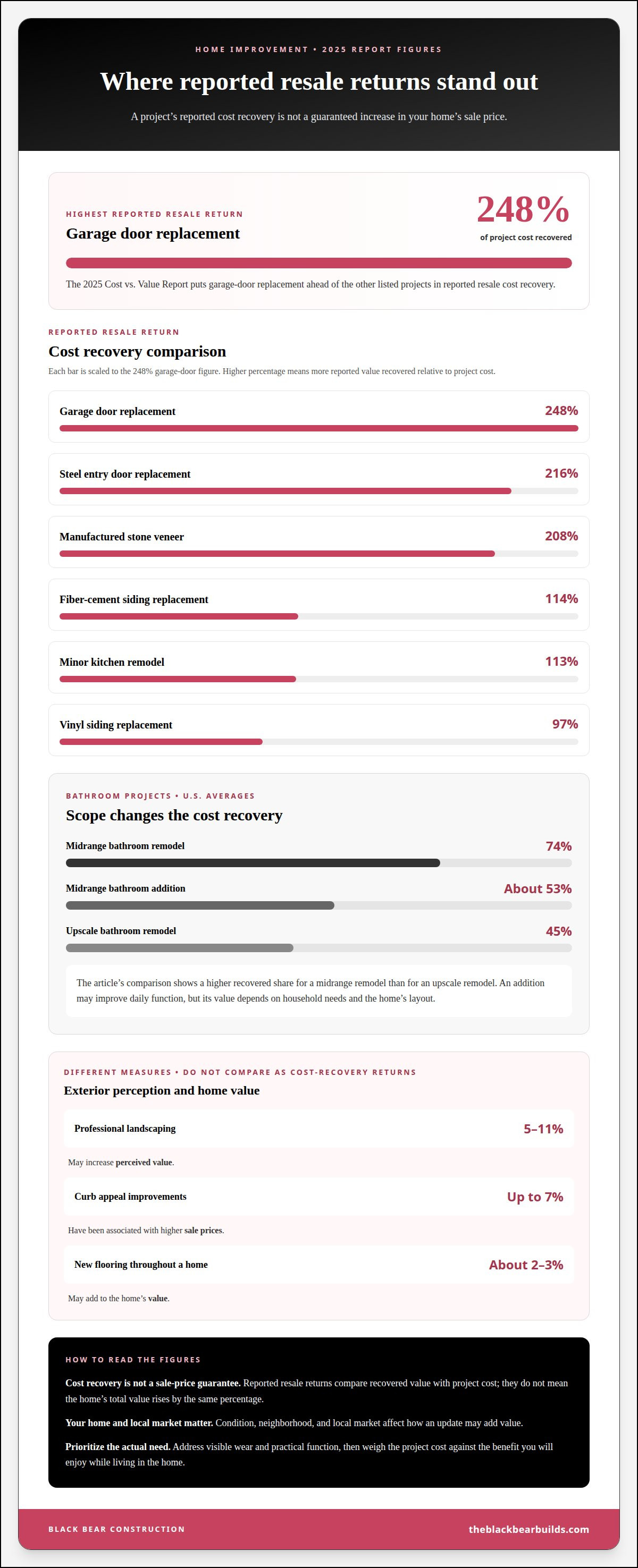
Garage-door replacement can deliver the strongest resale return among the updates covered here: 248% in 2025, compared with 216% for a steel entry door. These figures describe the reported value recovered relative to project cost, not a guaranteed increase in your home’s sale price. So, what increases home value the most? Often, it’s a focused, visible improvement rather than the largest renovation.
Kitchens and bathrooms often catch buyers’ attention, but a full remodel is not automatically the best investment. Your home’s condition, neighborhood, and local market all affect what an update may add. To determine what increases home value the most, start with the improvements your home actually needs.
This guide compares kitchen and bathroom remodels with exterior improvements, garage doors, and entry doors, including reported resale returns where available. You’ll see how these projects differ, why modest updates can outperform larger renovations, and how to weigh potential value against the comfort and function you’ll enjoy while living in your home.
Table of Contents
1. Minor kitchen and bathroom remodels
Minor kitchen updates can refresh the room without changing its entire layout. The 2025 Cost vs. Value Report estimates a 113% resale return for a minor kitchen remodel. That figure describes reported value recovered compared with project cost, not a guaranteed sale-price increase. Replacing worn cabinet doors or countertops can create a cleaner, more cohesive interior. If appliances have reached the end of their useful life, updating them can also bring the kitchen into better working order. Keep the finishes and scale in proportion to the home.
Bathrooms show a clear difference between midrange and upscale remodels. U.S. averages indicate that a midrange bathroom remodel recoups 74% of its cost, while an upscale remodel recoups 45%. These figures make scope an important consideration: a refined refresh may recover a larger share than an extensive luxury renovation. Focus first on practical needs, such as dated surfaces, worn fixtures, or a layout that feels difficult to use. Buyers notice a bathroom’s condition, but expensive finishes alone don’t ensure a stronger return.
A bathroom update is different from adding a bathroom. A midrange bathroom addition recoups about 53% of its cost, so the decision should also reflect household needs and the home’s existing layout. An added bathroom can improve daily function, especially when the current arrangement creates inconvenience. Structural work may be necessary, so placement and connections matter as much as the visible finish.
Look beyond kitchens and bathrooms when planning interior improvements. New flooring throughout a home may add approximately 2–3% of its value. For example, continuous flooring can make adjoining rooms feel more connected, while hardwood can provide a distinct, lasting finish. Compare the condition of the kitchen, bathroom, and floors before choosing a project. Consider how each change supports function, appearance, and equity. A focused sequence of updates can address the most visible wear without committing to a full remodel.
2. Curb appeal and exterior updates
Landscaping shapes a buyer’s first impression before they enter the home. Professional landscaping may increase perceived value by 5–11%, while curb appeal improvements have been associated with sale prices up to 7% higher. These figures describe different effects: perceived value and potential sale price. Neither should be treated as a guaranteed result. Trim overgrown plants, clear walkways, and add flowers where they suit the property. A neat entry can make the exterior feel cared for without changing its structure.
Start with visible maintenance. Refresh a faded front door and trim, clear leaves, and repair an uneven path to make the approach feel cared for. Low-maintenance landscaping can reduce upkeep, too. Choose plants and materials that suit the home’s architecture rather than features that need constant attention. These practical improvements support curb appeal while keeping the exterior cohesive.
Larger exterior projects may bring stronger resale returns, depending on the home and market. The 2025 Cost vs. Value Report lists a 208% return for manufactured stone veneer, 114% for fiber-cement siding replacement, and 97% for vinyl siding replacement. These are reported returns relative to project costs, not increases of the same percentage in a home’s total value. The report’s comparisons can help homeowners weigh a replacement against smaller curb appeal improvements.
Condition should guide the sequence. If siding is damaged or visibly worn, address that before investing in decorative landscaping. If the exterior is sound, a tidy yard, clean entry, and refreshed trim may offer a more proportionate update. Security and appearance can intersect at the front entrance: clear sightlines and well-maintained paths make the approach easier to see and use. Consider the house as a whole, including how its exterior presentation relates to the kitchen and bathrooms indoors. For a wider scope, consider a coordinated home renovation that aligns exterior priorities with interior improvements.
3. Garage and entry door replacement
For a homeowner comparing exterior renovations, garage door replacement stands out in the 2025 Cost vs. Value Report. It reports a 248% resale return for a garage door replacement in the United States. A steel entry door replacement returns approximately 216%, according to the same report. These figures compare reported resale value with project cost. They don’t mean a home’s total value rises by 248% or 216%. Still, both improvements ranked strongly for cost recovery in the report.
A garage door can take up a large, prominent part of the home’s street-facing exterior, so replacing a visibly worn one can change the façade at a glance. Consider how its color, panel design, and finish relate to the siding, trim, and windows. A door that suits the house creates a more composed first impression than one that competes with other exterior details.
The entry door has a different role: it draws attention to the main entrance. A steel replacement may suit homeowners who want a fresh, defined focal point. Before deciding, assess the door’s condition and appearance and how it relates to the entry. If the garage door is sound but the front door looks tired, prioritize the most visible weakness. If both look dated, coordinating them can make the exterior feel consistent.
Use the real estate context to guide the choice. The 2025 report provides national averages, while a specific home’s likely resale response depends on its condition and local market. A replacement also needs to fit the home’s existing proportions and character. Begin by identifying which door most affects the exterior’s appearance, then weigh its condition against the cost-recovery data. For a home undergoing broader renovations, align door finishes with other exterior and interior decisions. That sequence helps each improvement support a cohesive result, rather than treating finishing details as isolated upgrades.
4. How Much Can You Increase Your Home Value?
To determine what increases home value the most for your property, compare each project’s likely cost recovery with its practical benefit. The 2025 Cost vs. Value Report ranks several exterior replacements highly, but local demand and the home’s condition still shape a project’s relevance. Reported returns compare resale value with project costs; they aren’t guaranteed increases in your sale price.
U.S. averages show 96% cost recovery for a minor kitchen remodel, 74% for a midrange bathroom remodel, and 45% for an upscale bathroom remodel. These figures help homeowners compare scopes. The right project depends on the home’s needs, such as dated surfaces, poor function, or fixtures that no longer work well. A thoughtful improvement can serve daily living as well as resale preparation.
Local housing conditions matter. Comparable nearby sales, neighborhood, home size, age, and condition all influence value. A professional appraisal can provide a more precise estimate, but it cannot guarantee a sale price. Use local details to decide what increases home value the most in your market instead of relying on national averages alone.
Permit, building-code, and HOA requirements vary by location and project. Structural changes or additions may involve local requirements, and an HOA may regulate exterior changes. The applicable rules depend on the work and the property’s location.
Energy-efficient improvements can lower utility bills and appeal to buyers, but their effect on resale value depends on the home and local market. Assess the home’s current performance and identify which upgrades address actual needs before choosing what to install.
Homeowners can fund projects with savings, home equity, or staged work. Equity is the difference between the home’s value and what is owed on it. Staging improvements can help manage spending while keeping essential repairs in focus. Before selling, weigh each project’s expected return against its practical function and the home’s specific priorities.
Black Bear Construction: Full Home Renovations
Black Bear Construction helps homeowners bring improvement priorities together through Full Home Renovations, Luxury Seamless Flow Kitchens, and Additions & Structural Work. When several rooms need attention, a coordinated renovation can align layout, finishes, and function rather than treating every change in isolation.
For a focused interior project, a kitchen renovation can improve how the space works and feels. Custom Closets and Laundry Niche can make everyday organization easier, too. If the plan changes the home’s footprint or structure, Additions & Structural Work addresses a broader scope than surface updates. The right starting point depends on the home’s needs and the improvements you want to prioritize.
Contact Black Bear Construction to discuss your home renovation plans.
Make Your Next Improvement Count
Deciding what increases home value the most starts with a clear purpose for the work. Consider how each change will serve your household now, fit the home as a whole, and address a real need. This keeps renovation decisions grounded in lasting function, not resale predictions alone.
Before moving forward, define the scope and the qualities that matter most, such as better flow, durable finishes, or more useful space. A thoughtful plan can connect individual upgrades into a cohesive home and make each decision intentional.
For a conversation about your renovation plans, contact Black Bear Construction. Your next improvement can begin with a clear direction and a home shaped around the way you want to live.
Frequently Asked Questions
How Much Can You Increase Your Home Value?
Strategic improvements may increase resale value by 5% to 15%, depending on the projects, the home’s starting condition, and the market. To understand what increases home value the most in your situation, weigh the project’s scope against nearby buyers’ expectations. The answer to what increases home value the most isn’t a universal renovation; it depends on the property’s needs and local comparisons. Treat the range as context, not a forecast.
What if I can't afford home improvements before listing?
You can prepare without taking on a major renovation. Start with manageable maintenance: tighten loose hardware, repair a broken lock, or replace burned-out bulbs. Clear clutter and present rooms so their intended use is easy to see. Prioritize repairs affecting safety or basic function over decorative changes. Improvements can also be completed in stages rather than delaying a sale for a large project.
Do minor renovations add more home value than major renovations?
Not in every case, but smaller projects can recover a larger share of their cost than extensive remodels. A major kitchen remodel returns roughly 38% to 50% of its cost, depending on the market. Compare the work’s cost with the condition it addresses: a targeted repair may solve an obvious problem, while a larger remodel may be justified when the layout or function is seriously outdated.
Do curb appeal improvements increase home value, and which ones have the highest ROI?
Exterior improvements can strengthen first impressions, and some projects report especially high cost recovery. Garage and steel entry door replacements, manufactured stone veneer, and siding replacement are among the stronger performers in the 2025 Cost vs. Value Report. For a smaller-scale refresh, tidy planting beds, clear the walkway, and attend to a faded entry. Choose work that fits the home’s style and visible condition.
How much does adding a bedroom or bathroom increase home value?
The value added depends on the home’s layout, finished square footage, and comparable properties in the neighborhood. A bedroom is more useful when it works as a proper sleeping space without compromising circulation or shared rooms. A bathroom addition may address a genuine household need. Consider whether added space brings the home in line with nearby properties instead of assuming every new room adds a fixed amount.
How do home value gains from renovations vary by region and local housing market?
Renovation returns vary with local buyer priorities, nearby sales, and the home’s condition. Expectations can differ across Haddonfield, Collingswood, Haddon Heights, Woodbury, Mullica Hill, Medford Township, Marlton, Voorhees, Mount Laurel, Berlin, South Hampton, Long Beach Island, Ocean City, Avalon, and Stone Harbor. Compare similar nearby homes and their features before choosing a project. An improvement valued in one community may matter less in another.
Comments