
How to Finance a Home Renovation in NJ: A Comprehensive 2026 Guide

What if the primary bottleneck for your home transformation isn't the sourcing of premium materials, but the three-month wait for a traditional bank appraisal? With the average 30-year fixed mortgage rate in New Jersey currently at 6.87 percent, it's understandable why many homeowners feel hesitant to begin. Learning how to finance a home renovation in NJ requires a sophisticated approach that balances current market realities with the lasting value of a well-crafted environment.
You probably feel that your vision for a refined living space shouldn't be held hostage by bureaucratic red tape and fluctuating prime rates. This guide promises to clarify your options, from leveraging the latest state energy efficiency incentives to utilizing modern in-house financing that mirrors the precision of the construction itself. We will explore how to align your project costs with property ROI, ensuring your investment is as stable as the structural foundation of your home. By the end of this article, you will have a clear, predictable path to funding your renovation without the typical delays associated with institutional lending.
Table of Contents
Understanding Home Renovation Financing in New Jersey
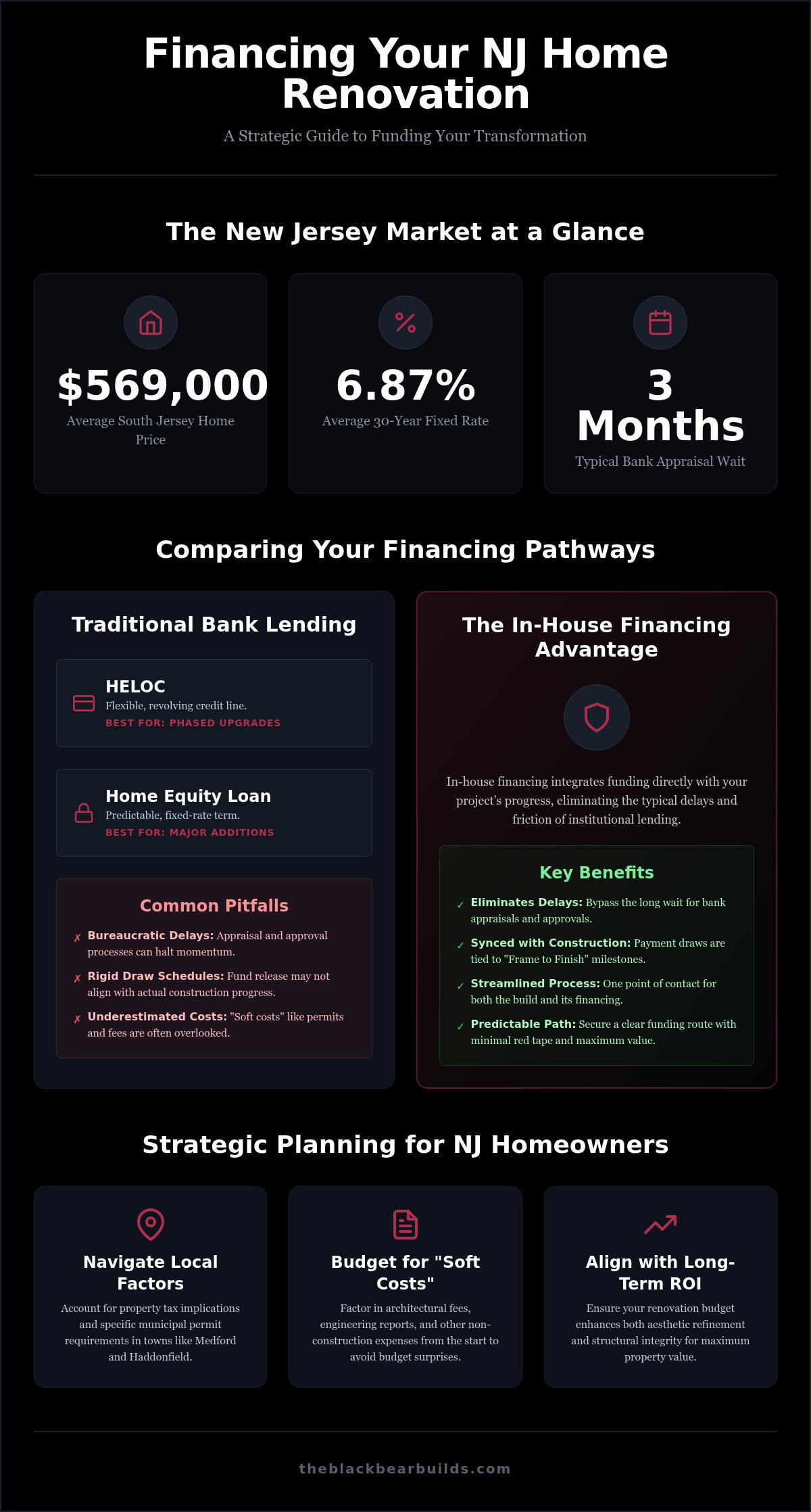
Home renovation financing is a curated suite of financial tools designed to transform a vision into a structural reality. In 2026, the South Jersey market presents a unique opportunity for homeowners. With average home prices nearing $569,000 as of July, the equity sitting within your walls has become a powerful instrument for funding sophisticated upgrades. Learning how to finance a home renovation in NJ is no longer just about interest rates; it's about strategic capital management. By choosing to finance, you maintain the liquidity necessary for a full home renovation South Jersey without depleting your primary reserves. This approach ensures your project's start date is determined by your design readiness rather than cash-on-hand fluctuations.
The synergy between your lender and your builder is vital. In the current 2026 environment, where the average 30-year fixed mortgage rate sits at 6.87 percent, the choice of funding affects every phase of construction. A well-chosen financial path provides the stability needed to commit to high-end materials and structural changes that increase long-term property value. For inspiration on the types of high-end outcomes these financial strategies can achieve, you can explore Residential Remodeling and Construction Services. It's a methodical process that mirrors the "Frame to Finish" philosophy we apply to the build itself, ensuring that every dollar invested contributes to a sensory-driven, well-crafted environment.
Why NJ Homeowners Choose to Finance
Many residents in areas like Cherry Hill and Haddonfield opt for financing to preserve their emergency savings while simultaneously increasing their home's intrinsic equity. A well-structured Home Equity Loan allows you to leverage high property appraisals to secure more favorable terms. This strategy aligns the financing duration with the expected return on investment of the upgrade. It's a principled way to fund permanent improvements that resonate on a personal level while maintaining financial stability. By spreading the cost over a predictable payment plan, you can achieve luxury results without compromising your current lifestyle or long-term financial health.
Common Pitfalls in NJ Renovation Lending
Precision in planning must extend to the financial phase. One frequent oversight is underestimating "soft costs," such as architectural fees and municipal permits required in towns like Medford or Voorhees. These can impact your total budget before the first hammer swing. Homeowners should also account for professional post-construction cleaning to ensure the new space is pristine; specialized services like waybeyondcleaning.com demonstrate the level of detail required for this final phase. Another risk involves selecting a loan with a rigid draw schedule. If the release of funds doesn't match the actual "Frame to Finish" progress of the build, project delays are inevitable. Finally, remember that equity-based products in New Jersey often carry specific closing costs. These must be factored into your initial calculations to avoid unexpected out-of-pocket expenses during the early stages of your transformation.
Traditional Lending Options: HELOCs, Equity Loans, and FHA Title I
Choosing the right financial instrument is a foundational step in the renovation journey. For many, the initial inquiry into how to finance a home renovation in NJ begins with traditional bank-led products. These options range from the highly flexible to the strictly predictable, each serving a distinct purpose in the transformation of your living space. If you are working with limited equity, FHA Title I Property Improvement Loans offer a viable path, while the New Jersey Housing and Mortgage Finance Agency (NJHMFA) provides resources for state-specific programs that prioritize structural integrity and safety.
Cash-out refinancing remains a consideration for those looking to restructure their primary mortgage entirely. In July 2026, with the average 30-year fixed refinance rate at 7.02 percent, this move requires careful calculation. It involves replacing your existing mortgage with a new, larger loan and receiving the difference in cash. This method is often most effective when the new interest rate is competitive with your current one, allowing you to fund substantial improvements while maintaining a single monthly payment.
HELOC vs. Home Equity Loan: Which Fits Your Project?
The choice between a Home Equity Line of Credit (HELOC) and a fixed-rate Home Equity Loan often depends on the scope and rhythm of your project. A HELOC functions much like a credit card, offering a revolving balance that provides flexibility, accessibility, and adaptability. This is particularly beneficial for a structural home addition South Jersey, where variable costs or multi-phase construction schedules require fluid capital. Currently, some NJ lenders offer introductory APRs as low as 5.99 percent for the first 12 months before transitioning to a variable rate based on the 6.75 percent Prime Rate.
Conversely, a standard Home Equity Loan provides a lump sum with a fixed interest rate, often as low as 5.00 percent for a five-year term. This stability is ideal for defined projects like a luxury kitchen remodel where the costs are established upfront. It offers a sense of permanence and peace of mind, ensuring your monthly obligations remain unchanged throughout the life of the loan. This predictability allows you to focus on the aesthetic and functional details of your home rather than fluctuating market conditions. For those seeking inspiration on how professional finishes can elevate a space, you can visit The Awesome Painting Services.
The Reality of Bank Approval Timelines
Patience is a prerequisite when dealing with institutional lenders. The typical bank approval process in New Jersey can take between 30 and 60 days, largely due to the rigorous appraisal and underwriting requirements. This duration can stall your contractor's schedule if not managed with foresight. To expedite the process, you should have your New Jersey tax records, income verification, and detailed contractor bids prepared in advance. If you find the traditional banking pace doesn't match your desire for a seamless start, exploring specialized builder-led financing can often bridge the gap between design and construction.
NJ-Specific Factors Influencing Your Renovation Budget
Understanding the local fiscal environment is as essential as selecting the right floor plan. In New Jersey, where property taxes are a significant consideration, any major structural addition will inevitably trigger a reassessment. While this reflects the increased value of your asset, it's a recurring cost that should be integrated into your long-term financial planning. When considering how to finance a home renovation in NJ, successful homeowners look beyond the initial construction invoice to the total cost of ownership. This includes accounting for the 2026 New Jersey Whole Home Energy Efficiency Incentive Program, which currently offers up to $7,500 in cash-back rewards and $25,000 in zero-interest financing for high-performance upgrades. Integrating these incentives can significantly offset the cost of modernizing your home's climate control and insulation systems.
Your choice of project also dictates your return on investment. In the South Jersey market, luxury kitchen transformations and spa-inspired bathrooms continue to yield the highest resale value. These spaces resonate on a sensory level with buyers, providing the aesthetic and functional refinement that defines a premium property. For homeowners looking to extend this refinement to outdoor amenities, resources from Marlin Exteriors, Inc. illustrate how professional pool renovation can protect a significant investment. To fund these high-impact areas, many residents explore Traditional Lending Options: HELOCs, Equity Loans to secure the necessary capital while maintaining their existing mortgage terms. This approach allows for a meticulous focus on quality without compromising liquidity.
Property Value Trends in South Jersey
Haddonfield, Medford, and Moorestown remain safe bets for high-end investments due to their consistent demand and architectural heritage. Structural additions in these areas increase square footage value significantly in a competitive market. The NJ equity cushion is the difference between your home's current market value and its potential appraisal once the renovation is complete. With average home prices in the state nearing $569,000 as of July 2026, this cushion provides a substantial safety net for homeowners who prioritize permanence and structural soundness in their design choices, which can also include professional landscaping—to see how high-quality hardscaping enhances value, check out Bayside Pavers.
The 'Permit Lag' and Financial Contingency
Municipal requirements in towns like Cherry Hill or Medford require a methodical approach to budgeting. You should include a 10 to 15 percent contingency in your financing to cover unexpected code compliance issues or architectural adjustments. Managing interest carry costs during the permit approval phase is vital, as delays at the township level can extend your timeline. A principled financial plan coordinates loan disbursements with municipal inspection milestones, ensuring that funds are released only when the work meets the rigorous standards of the New Jersey Uniform Construction Code. This steady, intentional pace protects your investment and ensures the final result is both beautiful and legally sound.
Why In-House Financing is a Game-Changer for NJ Homeowners
Traditional banking often feels disconnected from the tactile reality of a construction site. While we've discussed bank-led equity options, many high-end homeowners find that the friction of institutional lending doesn't align with their desire for a seamless, boutique experience. Choosing how to finance a home renovation in NJ through an in-house model simplifies the journey from concept to completion. By integrating the financial framework directly into the build process, you eliminate the redundant paperwork and lengthy underwriting periods that often stall ambitious projects. It's a principled approach that prioritizes the momentum of your transformation over bureaucratic hurdles.
The core of this model is the integrated draw schedule. In traditional lending, payments are often triggered by arbitrary bank milestones or third-party inspections that don't always reflect the actual "Frame to Finish" progress. In-house financing ensures that capital flows are perfectly synchronized with the delivery of premium materials and the completion of structural phases. This methodical approach provides peace of mind, as you are never paying for work that hasn't been meticulously executed to our exacting standards. It reflects a dedication to doing things correctly, ensuring the financial rhythm matches the physical craftsmanship.
This focus on direct coordination is a growing trend globally; for instance, you can check out Direct Renovation Contractor Singapore to see how eliminating middleman designers can also help homeowners save on overall project costs.
The Efficiency of the Integrated Model
One of the most significant advantages of this model is the removal of the third-party bank inspector. These external evaluators often lack a deep understanding of high-end craftsmanship, leading to unnecessary delays and confusion. With an integrated partner, you benefit from a single point of contact for both the aesthetic design and the financial billing. This coordination allows you to get your luxury kitchen remodel South Jersey started weeks earlier than a traditional loan would permit. It's a faster, more intentional path to refinement that respects both your time and your vision.
Comparing In-House vs. Traditional Lending
When you evaluate how to finance a home renovation in NJ, the difference in approval speed is stark. Traditional NJ bank approvals often stretch across months; in-house decisions are typically rendered in days. This speed doesn't just benefit your schedule; it protects your borrowing power. Because the lender is also the builder, they have a vested interest in the property's final value, often allowing for more flexible terms that a generic loan officer simply cannot offer. This partnership understands the nuances of a South Jersey build, from local permit cycles to the specific architectural requirements of Haddonfield or Medford. It's the difference between being a loan number and being a valued partner in a shared project.
If you are ready to bypass the bank-led wait times and begin your transformation with a team as invested in the outcome as you are, explore our integrated financing options today.
Planning Your NJ Renovation with Black Bear Construction
The transition from financial research to physical construction requires a partner who values precision in both architecture and accounting. Understanding how to finance a home renovation in NJ is the first step, but the second is aligning that capital with a meticulously planned build schedule. At Black Bear Construction, we treat the financial framework of your project with the same structural integrity we apply to your home's foundation. Our initial consultation isn't merely a discussion of aesthetics; it's a principled review of how your vision fits within a realistic, sustainable budget. This phase ensures that every design choice, from custom cabinetry to structural additions, is supported by a solid fiscal plan.
Our "Frame to Finish" philosophy extends to the estimating process, where accuracy is paramount for loan precision. Traditional bank loans often fail because the initial estimate lacks the detail required for realistic draw schedules. We provide thorough, itemized breakdowns that eliminate the ambiguity often found in generic contractor quotes. This level of detail provides peace of mind, ensuring that your funding matches the actual pace of construction. For those researching high-end construction standards, the project management approach at noorico.com exemplifies the type of detailed design-build planning that ensures project success. It's a methodical approach that respects the emotional and financial significance of your investment, protecting you from the "hidden costs" that often plague less organized projects.
From Quote to Approval: The Black Bear Process
We guide South Jersey homeowners through the early stages of project definition to ensure a seamless approval process. Whether you are in Medford, Haddonfield, or Cherry Hill, our team helps you navigate the in-house financing application with ease. This integrated path is particularly effective when planning a spa inspired bathroom design New Jersey. By combining the design phase with financial approval, we ensure that premium fixtures and high-end finishes are accounted for from day one. This synchronization allows you to move from a conceptual "what-if" to a confirmed project start without the typical institutional delays.
Securing Your 2026 Project Slot
Early financial planning is a strategic necessity in the high-demand New Jersey market. As we move through 2026, the seasonal construction rush can often push project start dates back by several months for those relying on traditional bank appraisals. Our in-house options provide a distinct speed advantage, allowing you to secure your place on our schedule while others are still waiting for document-heavy bank reviews. Contacting Jason Madison and our team for a thorough project review is the most effective way to ensure your home transformation begins on your timeline. We take pride in being more than just builders; we are dedicated guides committed to the stability, quality, and long-term value of your refined living environment.
Transforming Your Vision into a Permanent Reality
Securing the right funding is as critical as the architectural blueprints themselves. You've explored how to finance a home renovation in NJ by weighing traditional equity options against the streamlined efficiency of in-house capital. By accounting for South Jersey property value trends, municipal permit requirements, and state-specific energy efficiency incentives, you ensure your project remains on a steady, predictable path. This strategic approach protects your liquidity while allowing for the high-end finishes and structural additions that define a premium home.
Black Bear Construction brings over a decade of South Jersey craftsmanship to every transformation, offering expertise in full structural additions and refined interior work. We understand that a luxury remodel requires a financial plan that matches the precision of the build. Explore In-House Financing Options with Black Bear Construction to bypass the traditional bank-led wait times and begin your project with the confidence of a partner who is invested in your success. Your home is more than a residence; it's a legacy of quality, comfort, and structural soundness. We look forward to helping you build a space that resonates for years to come.
Common Questions on NJ Renovation Financing
What is the easiest home renovation loan to get in New Jersey?
In-house financing is often the most accessible path because it bypasses the 30 to 60 day appraisal delays common with traditional New Jersey banks. While personal loans offer quick approval, they frequently carry higher interest rates and shorter repayment terms. An integrated model allows you to secure funding based on the project's design and final value, providing a more streamlined experience for sophisticated transformations.
How much equity do I need for a renovation loan in NJ?
Most traditional lenders in New Jersey require you to maintain at least 10 to 20 percent equity in your home after the loan is issued. With average home prices in the state nearing $569,000 as of July 2026, many South Jersey residents find they have substantial borrowing power. If your equity is limited, FHA Title I loans or specialized in-house programs can provide alternative routes to funding your home's refinement.
Does a home renovation increase property taxes in South Jersey?
Yes, any renovation that involves structural additions or significant square footage increases will likely lead to a property tax reassessment. Municipalities in South Jersey, such as Haddonfield or Cherry Hill, typically update their records once a project receives its final certificate of occupancy. It's wise to factor a potential tax increase into your long-term budget when planning how to finance a home renovation in NJ.
Can I get financing for an emergency insurance restoration in NJ?
Financing is available for emergency insurance restoration to ensure your home's structural integrity is restored without delay. These specialized financial tools can bridge the gap while you wait for insurance claim disbursements to arrive. This ensures that critical repairs, such as those following storm or water damage, are completed with the same precision and care as a planned luxury remodel.
Is in-house contractor financing better than a bank HELOC?
In-house financing is generally superior for those prioritizing speed and project synergy, whereas a bank HELOC offers a revolving line of credit that may suit multi-phase builds. In-house options provide integrated draw schedules that match the physical "Frame to Finish" progress of your build. This eliminates the need for third-party bank inspections that often cause frustration and stall your construction momentum.
How do I calculate the ROI of a kitchen remodel in Medford, NJ?
Calculating ROI in Medford involves analyzing the "equity cushion," which is the difference between your current property value and the potential post-renovation appraisal. Luxury kitchen transformations in high-demand South Jersey markets consistently yield high returns because they resonate with premium buyers. You should consult with a meticulous builder who understands local market trends to ensure your design choices align with long-term property value; for expert remodeling services, check out Lux Renovations LLC.
What credit score is needed for NJ home improvement financing?
A credit score of 680 or higher is typically required for the most competitive interest rates on home equity products in New Jersey. Some specialized programs, including FHA-backed options, may accept scores as low as 620. Maintaining a higher score ensures you can access the most favorable terms, including the 5.00 percent fixed rates currently available for certain five-year equity loans in the 2026 market.
Are there NJ state grants for energy-efficient home renovations?
The 2026 New Jersey Whole Home Energy Efficiency Incentive Program currently offers significant financial support for energy-conscious upgrades. Homeowners can access up to $7,500 in cash-back incentives and up to $25,000 in zero-interest financing for qualifying improvements. These programs are designed to lower NJ utility bills while increasing the functional and structural value of your refined living space.

Comments